 Save to Pinterest
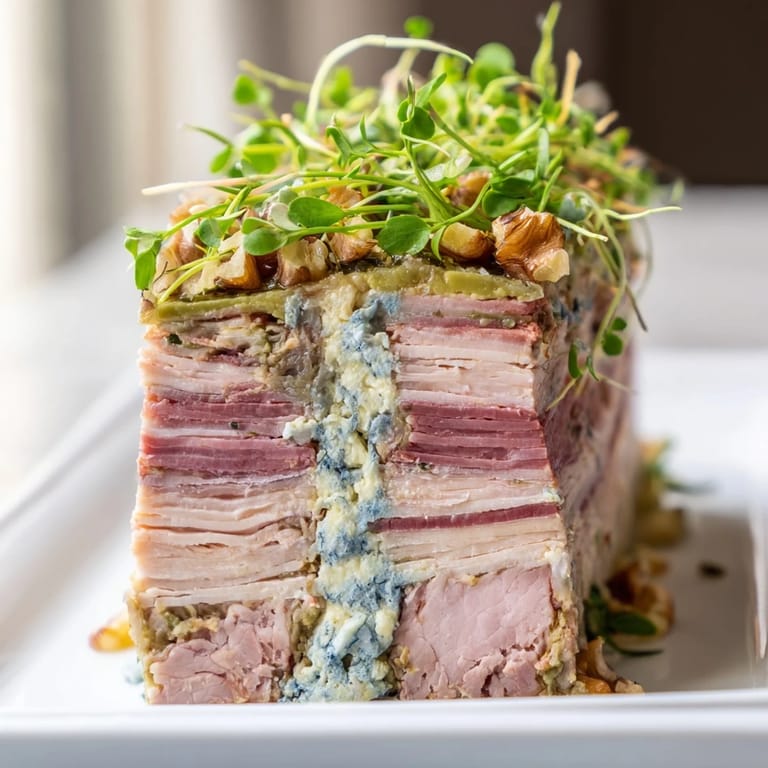
 I first encountered a Grand Canyon terrine at a dinner party where the host unveiled it like a geological cross-section, and I was absolutely captivated by the way those meat layers created actual cliff faces on the plate. The blue cheese vein running through the center looked exactly like a river carved through stone, and I knew right then I had to recreate it. What struck me most wasn't just the visual—it was how the flavors built and shifted with each layer, how the richness of the meats contrasted with that bold, almost mineral quality of the blue cheese. I spent weeks figuring out the technique, testing whether to slice the meats thin, how much binding would hold everything together without making it dense, and where exactly that cheese river needed to sit to create the most dramatic reveal. This dish became my favorite kind of cooking challenge: one that required both precision and creativity.
I remember bringing this to a potluck last autumn, nervous the whole drive there because I'd never transported it before, and when I unmolded it right at the table, the room went completely quiet for a second before everyone crowded around with phones out. One guest asked if I'd taken a geology course, another kept saying they couldn't believe it was actually meat, and suddenly I understood why people keep making intimidating dishes—it's not just about the food, it's about that collective moment of surprise and delight.
Ingredients
- Beef sirloin, thinly sliced (300 g): Lean and flavorful, it forms your base layers and holds up beautifully to the binding mixture without becoming tough.
- Turkey breast, thinly sliced (250 g): Milder than the beef, it creates visual separation and keeps the overall richness in check.
- Smoked ham, thinly sliced (200 g): This brings a subtle smokiness and deeper color variation that mimics actual canyon geology.
- Pork loin, thinly sliced (200 g): Tender and delicate, it adds another flavor dimension and a slightly lighter hue to your layered effect.
- Blue cheese, crumbled (150 g): The star of the river—get a good quality one with real funk, because timid blue cheese disappears into the background.
- Cream cheese, softened (100 g): This makes the blue cheese mousse spreadable and holds it together as it sets.
- Heavy cream (30 ml for mousse): Whip it gently into the cheese mixture for an airy, almost luxurious texture.
- Fresh chives, finely chopped (1 tbsp): A delicate green note that brightens the earthy richness.
- Fresh parsley, finely chopped (1 tbsp): Adds herbaceous freshness and a tiny pop of color in the mousse.
- Eggs (4 large): These bind everything together with the milk and cream into a silky custard-like layer.
- Whole milk (120 ml): Part of your binding mixture, it keeps things from becoming too heavy.
- Heavy cream for binding (60 ml): Richness and structure in the custard layers.
- Salt and black pepper: Season generously—this dish needs confident seasoning to sing.
Tired of Takeout? 🥡
Get 10 meals you can make faster than delivery arrives. Seriously.
One email. No spam. Unsubscribe anytime.
Instructions
- Set your stage:
- Preheat your oven to 160°C and line a standard loaf pan with plastic wrap, letting it hang over the edges like you're tucking in a child—you'll need that overhang to seal everything at the end.
- Make your binding custard:
- Whisk together the eggs, milk, heavy cream, salt, and pepper until completely smooth and pale, then set it aside; this is what will hold your meat layers together into a cohesive terrine.
- Blend your blue cheese river:
- Combine the crumbled blue cheese with softened cream cheese, then gently fold in the heavy cream until you have a mousse that's spreadable but still holds its shape; this is your dramatic centerpiece.
- Layer your canyon walls:
- Starting at one side of the pan, arrange your beef slices so they overlap slightly and angle downward like a cliff face, then add turkey, then ham, then pork, continuing this angled pattern as if the meats are actually tumbling down the sides of a real canyon.
- Bind as you build:
- After every two or three meat layers, lightly brush some of that custard mixture across the surface—enough to bind but not so much it pools and creates pockets of set custard.
- Carve your river:
- When you're roughly halfway up the pan, spoon that blue cheese mousse down the center in a thick stripe, then continue layering meats around and over it, angling them so the river stays visible from the sides.
- Seal and support:
- Finish with a final layer of meat, then fold that plastic wrap overhang back across the top to seal in moisture, then cover everything tightly with foil to create an airtight seal.
- Water bath your creation:
- Place your loaf pan inside a larger roasting dish and fill the roasting dish with hot water until it comes halfway up the sides of the loaf pan—this gentle, even heat keeps the terrine from drying out.
- Bake with patience:
- Slide everything into the oven for 1 hour and 15 minutes; you're not looking for browning, just a gentle set and a faint firmness when you press the top lightly.
- Cool completely:
- Remove from the oven and let it rest at room temperature for a couple of hours, then transfer to the refrigerator for at least 4 hours, or ideally overnight—this is when the layers truly set and the flavors marry.
- Unmold with ceremony:
- Run a thin knife around the edges, then invert the terrine onto a serving platter and peel away the plastic wrap slowly; take a breath, because what you've created is about to reveal itself.
- Slice and reveal:
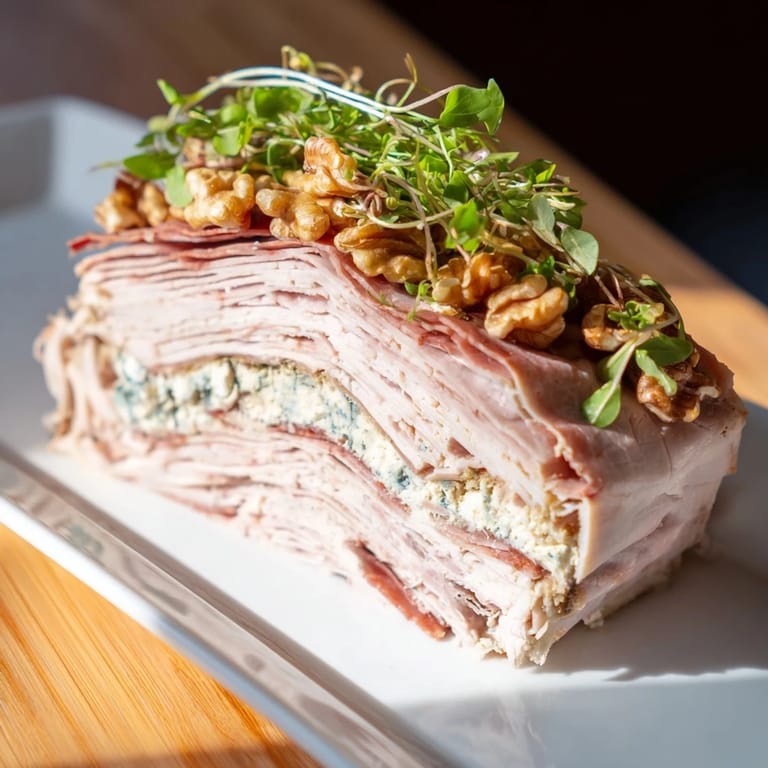
- Using a hot, wet knife (rinse and wipe between cuts), slice thickly so each portion shows all those gorgeous layers and that blue cheese river in cross-section.
 Save to Pinterest
 The first time someone cut into this at a table and that blue cheese river appeared in perfect profile, suddenly everyone understood why I'd spent so much time perfecting it—it stopped being dinner and became a conversation, a small shared moment of wonder that food rarely creates.
The Slicing Technique That Changes Everything
I learned the hard way that how you slice this terrine matters as much as how you make it. A dull knife will compress the layers and blur that beautiful definition, but a hot knife dipped in water creates clean, almost architectural slices where every layer reads distinctly. Between each cut, I dip my knife in hot water and wipe it dry—it takes maybe thirty seconds longer per slice but absolutely transforms the presentation from jumbled to pristine.
Variations and Flavor Substitutions
Once you understand the basic structure, this terrine becomes a canvas for your own creativity and whatever you have on hand. I've made versions with smoked duck and prosciutto for deeper richness, swapped the blue cheese for herbed goat cheese when I wanted something brighter and more delicate, and even experimented with a layer of pâté for extra luxury. The architecture stays the same—what changes is the flavor story you're telling.
Serving and Pairing Wisdom
This dish shines when you give it room to breathe on the plate, served with something that cuts through its richness without competing for attention. Toasted brioche brings warmth and textural contrast, crusty bread offers structure for smaller bites, and a simple dressed salad with vinaigrette refreshes your palate between slices. The right wine makes it even better—I've had beautiful results with light reds like Pinot Noir that don't overpower, and crisp whites like Sauvignon Blanc that add brightness.
- Let the terrine sit at room temperature for 10 minutes before slicing to let the flavors warm up and open.
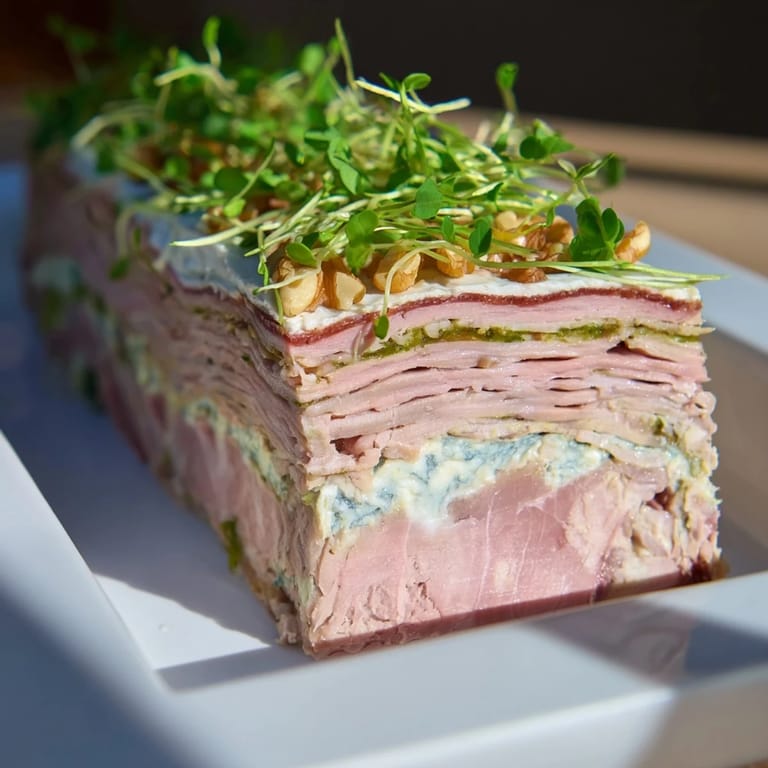
- Plate it slightly off-center on the platter so the cross-section of layers faces out toward your guests.
- Save any scraps—they're perfect layered into sandwiches the next day for a secret second life.
 Save to Pinterest
 This terrine proves that cooking doesn't need to be complicated to be memorable—it just needs to be made with intention and a little courage. Every time you slice into it and reveal those layers, you're creating a small moment of joy.
Recipe FAQs
- → What meats are used to create the layers?
The terrine layers include thinly sliced beef sirloin, turkey breast, smoked ham, and pork loin to build the canyon-like effect.
- → How is the blue cheese mousse prepared?
The mousse combines crumbled blue cheese, cream cheese, heavy cream, chives, parsley, and black pepper, blended until smooth.
- → What cooking method is used to bake the terrine?
The layered loaf is baked in a bain-marie, which gently cooks it with indirect heat to maintain moisture and texture.
- → How long should the terrine chill before serving?
After baking, the terrine should chill for at least 4 hours, preferably overnight, to set properly.
- → Can I substitute any ingredients for different flavors?
Smoked duck or prosciutto can replace some meats for a smoky twist, and herbed goat cheese can swap for blue cheese in the mousse.